IPTV Social Media FAQ

❓ Connection

Guides, tutorials and frequent answers. The FAQ is continuously improving.

All Internet VPN

Questions

Categories

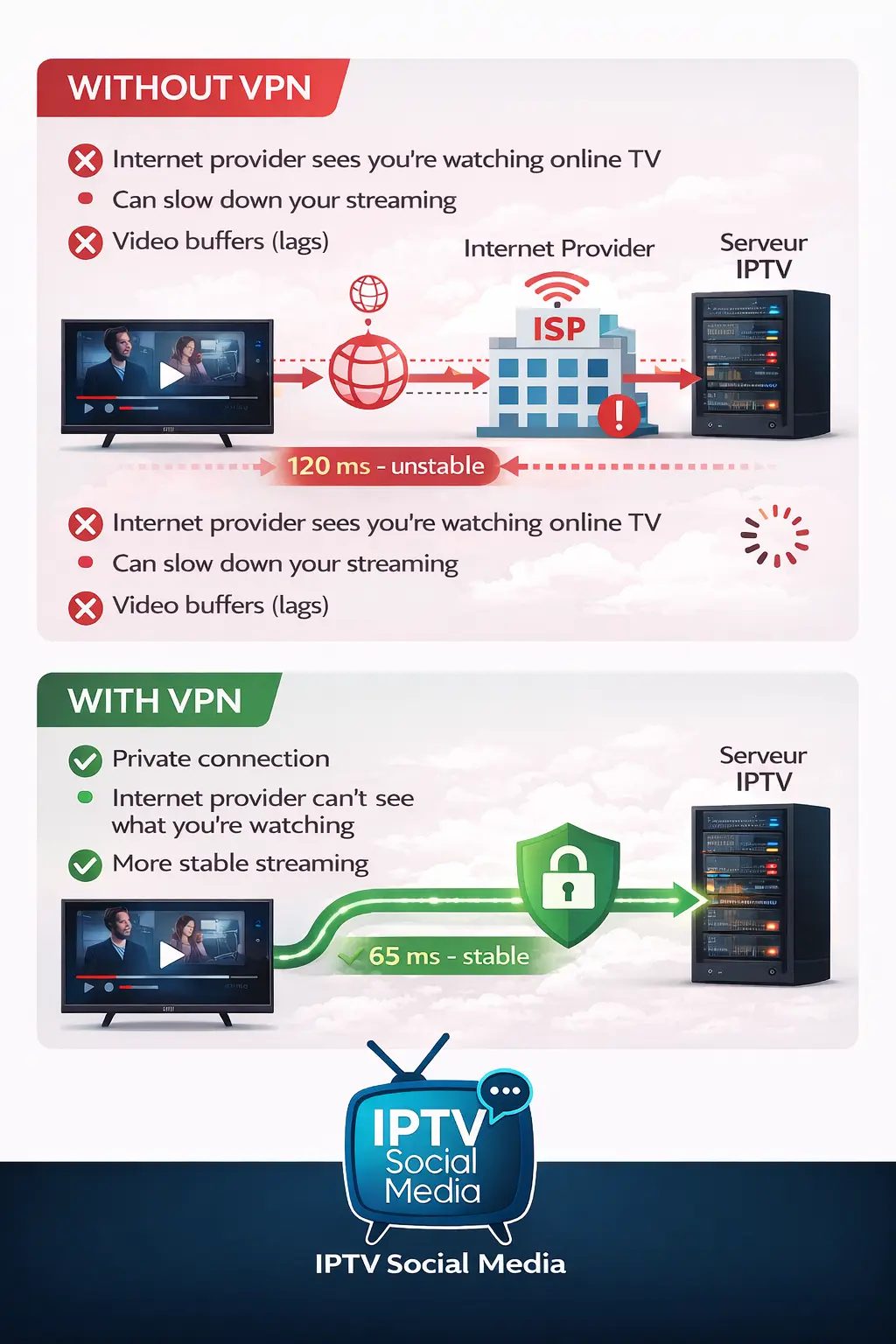
A VPN (Virtual Private Network) protects your internet connection by encrypting your data and hiding your real IP address.

When using IPTV services, internet providers may detect streaming traffic and apply automatic restrictions such as throttling, blocking, or instability.

A VPN creates a secure tunnel between your device and the internet. This helps to:

  • Protect your privacy
  • Avoid certain blocks or restrictions
  • Improve streaming stability
  • Reduce buffering issues

In most cases where users experience freezing or playback errors, activating a VPN resolves the issue immediately.

We strongly recommend using a reliable and fast VPN for the best streaming experience.
 

The internet speed shown (ex: 100 Mbps or 1 Gbps) does not guarantee a stable connection.

IPTV depends more on connection stability than on maximum speed.

Common causes:

  • Unstable or intermittent connection
  • High ping (latency too high)
  • Street cable or ISP infrastructure issues
  • Weak WiFi or too far from the router
  • Multiple devices using the internet at the same time

You can have 1 Gbps and still experience freezing if the signal is not consistent.

Important: IPTV requires a stable and clean connection. A stable 50 Mbps fiber connection can work better than an unstable 1 Gbps cable line.

Simple tip: test IPTV using a wired Ethernet connection directly to your router to see if WiFi is the problem.

For IPTV, it is important to choose a fast and stable VPN.

One of the most commonly recommended VPNs in the IPTV community is NordVPN.

Why NordVPN?

  • Very fast and stable
  • Works on Android TV, Firestick, phone and computer
  • Allows up to 5 devices connected at the same time
  • Easy-to-use application

We usually recommend choosing a 2-year plan because it saves a lot of money per month.

Important: avoid free VPNs. They are often slow, overloaded and can cause more buffering.

You can purchase NordVPN directly from their official website:
https://nordvpn.com

Important tip:
If your country’s server seems slow (ex: Canada at 7PM), try a country where it is late at night (ex: France or Europe).

Fewer people connected = less server congestion = sometimes smoother streaming.

Test different countries and keep the one that works best for you.

For IPTV, the best connection is always a wired Ethernet cable.

A wired connection is more stable, more consistent, and less sensitive to interference than WiFi.

We recommend:

  • Using the cable provided with your modem or router
  • Buying a pre-made certified Ethernet cable
  • Avoiding old or homemade cables

An old or poorly assembled cable can cause instability even if your internet speed is high.

What about WiFi?

WiFi can work, but it is more sensitive to walls, distance, and interference.

If using WiFi:

  • Stay close to the router
  • Avoid 5G WiFi if your device is not fully compatible
  • Run a speed test directly on your IPTV box

Ideally, WiFi speed should reach at least 80% of your wired speed to be considered stable.

Conclusion: for reliable IPTV streaming, Ethernet is always the safest choice.

A VPN can improve streaming stability, but it does not fix every problem.

If you still experience buffering, here are the most common reasons:

  • Old or slow device
  • Low RAM memory
  • Storage almost full
  • Slow or unstable internet connection
  • Very large M3U playlist (too many channels)

An older or low-powered device may struggle to load thousands of channels or modern IPTV apps.

Important: a VPN does not make your device more powerful.

If your box has 2GB of RAM or less, or is several years old, it may be time to upgrade.

Simple tip: restart your device, close unused apps, and test with another IPTV app if possible.

A speed test (like Speedtest) measures your maximum speed for a few seconds.

However, IPTV mainly requires a stable and consistent connection, not just high speed.

Here’s how to properly test your connection:

  • Run the test directly on your IPTV box, not only on your phone
  • Check your ping (latency): it should stay low and stable
  • Run tests at different times of the day
  • Try using an Ethernet cable instead of WiFi

You can have 300 Mbps on a speed test and still experience freezing if your connection is unstable.

If freezing mostly happens in the evening, it may indicate ISP congestion.

Tip: if possible, test your IPTV with a wired connection directly to your router to eliminate WiFi issues.

If your IPTV works fine in the morning but freezes in the evening, the issue is usually congestion.

Between 6PM and 10PM is peak internet usage time. Many people are online at the same time.

Common causes:

  • Multiple devices in the house using internet (YouTube, Netflix, gaming)
  • Online gaming consuming bandwidth
  • Overloaded WiFi
  • VPN server congestion during peak hours
  • ISP congestion in your neighborhood

In the morning, internet traffic is usually lower, which makes the connection more stable.

Simple solutions to try:

  • Use an Ethernet cable instead of WiFi
  • Change VPN server (try a country where it is late at night)
  • Restart your modem and router
  • Limit other devices using the internet while streaming

If the issue only happens in the evening, it is almost always congestion and not the IPTV service itself.

App home FAQ